Monday, 5 October 2015

Tribal Fusion Male Zenne Belly Dancers By Laura A. Munteanu

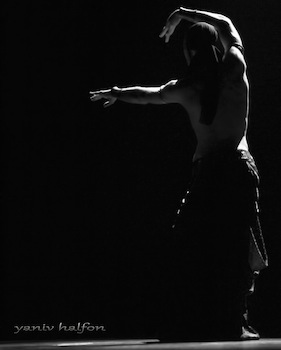
I recently encountered a cultural dance form that I found both challenging and with further study hypnotically beautiful. In America, this cultural presentation is a form of dance going under the label of Tribal Fusion, but a simpler description would be costumed male belly dance. 


                                     Photo: Horus Mozarabe, Tribal Fusion belly dancer

As a Romanian commentator, the Roma and Sinti part of my heritage responds to the romantic and exotic notions of the Lebanese, Turkish, Roma and Egyptian belly dance, particularly the athletic, the aesthetic and the sexual presentation of the performer's body framed by the costuming, accessories and escalating rhythms of the music. Whilst it is a popular misconception that belly dancing originated as the advertising foreplay of prostitution, the personal domestic and public presentations of belly dancing clearly, all involve a celebratory dynamic of sexual display. 


                                 Photo: Zadiel, Zenne belly dancer


The transpositions of the dance moves and the costumes to male performers appears on surface to be simply an extension of gay subcultures appropriation and mainstream dance culture, like vogueing. However, on closer inspection, despite Tribal Fusion's relatively recent origins in 1960s Californian Renaissance Fairs, seems to be much older and more complicated. 

Middle Eastern countries are not noted for their tolerance of homosexual culture. Yet, in Ottoman Turkey, particularly under the Ataturk period, male belly dancers were as common as female ones, if not slightly more prevalent. It appears, that the zenne dancer, a man who dressed as a woman, and danced for the titillation of predominantly male crowds has a long and complex cultural tradition, which nearly died out by the 1960s. Whilst not exactly inhabiting gay culture as we understand it, zenne dancing appears to inhabit a submissive niche for a dominant, penetrative elite. Whereas neither parts would describe themselves as homosexual, the zenne dancer performed a feminine role, which by definition of the Ataturk culture was a submissive and titillating role. 


In recent years, as a result of Caner Alper and Mehmet Binay's Turkish film "Zenne Dancer", on one hand, and american Tribal Fusion on the other, male belly dancing has undergone a cultural renaissance. In the face of religious fundamentalism in the region it appears to have shed its submissive dynamic, and it's now being performed as an assertive and defiant act by citizens, using it as a means of personal aesthetic and celebratory self esteem. 

Interestingly, just to add cultural confusion it's an aesthetic form which is now embraced by the heterosexual community, as well as the homosexual community.  And its resurgence it's possibly responsible for other similar displays in parallel art forms, such as the Bulgarian performer Azis, who's pop diva, lady-man performances have found inexplicable commercial success, in traditionally homophobic Bulgaria. 


Coming from a culture with a strong tradition of community dance, and living now in a culture with a more inhibited sense of dance I find the mutations evident in Tribal Fusion utterly fascinating. And I leave you the following links to make your own mind up, to introduce you to this cultural form of expression. 


Horus Mozarabe performing Tribal Fusion Belly Dance


Zenne Segah performing Turkish Belly Dance


Rachid Alexander performing Oriental Belly Dance


Bulgarian Chalga singer Azis 


Thursday, 1 October 2015

Being Batman By Laura A. Munteanu

It's difficult sometimes, to feel that I fit into this world I find myself in. And whilst it's true, but I'm not entirely sure what I'm looking for, it's equally true that I'm not entirely sure if I want what I've found. In the fireside tales of my distant youth I learnt about all sorts of complicated solutions to difficult problems, that involved turning yourself into an animal. A bird to fly over a high wall, a fish to swim to the bottom of the lake, a wolf to run through the strange forestland. I appreciate that these stories are probably just metaphors, prosaic descriptions of powerless people fantasising the subversion against the injustice of the authority figures that routinely crushed their aspirations. Those stories however planted a simple seed deep in my soul. A seed that has secretly grown that has infected my whole personality.

They used to say in my country that I have my head in the clouds. People would come up behind me and surprise me and tell me to wake up, making the jump for their amusement from my introspection. I used to be scared of the dark, imagining all the creaking noises that surrounded me in the dark were the sounds of claws scraping across the linoleum around my bed. Imagination can be an expensive problem if you are born into poverty or you find yourself in its arms. Nobody cares what the poor woman dreams, what shape she would like her community to take. And like the heroine in a Romanian folk story I packed my possessions into a small suitcase and sought my fortune in a foreign land. Whilst the road was hard, paved with scorn, mockery, dismissal or obstructions, I finally began to take some control over the direction of my life. And all the time through my years of struggle a little voice inside me urged me to ignore the scorn, the mockery and the folly of the fools around me, and to put myself in a position where my dreams could begin to make a difference.

This week, I found myself in Brighton, on the south coast of England, unexpectedly bracing itself for the invasion of thousands of Socialists for the Labour Party Annual Conference. Coming from a Communist country, Socialism is an ideology not entirely outside my experience, and compared with the divisiveness of conservativism, or the opportunism of liberalism is certainly closer to the colour of my political complexion. Having recently joined the party to deliberately support a left-wing leadership candidate I found myself somewhat isolated, at a very nervous conference, re-experiencing the changes the popular democracy brings. The moderate left-wing members of the party establishment were facing difficult decisions daily between their loyalty to the movement and their loyalty to their personal history of moderation. As a result, I found once you've fought past the desperate right-wing media scraping the streets of the stories that would damage the party's resurgence, the members of the party conference were either highly cautious not to express their opinion, or highly anxious to express their loyalty. Both positions being difficult for an outsider, a foreign outsider, to fully comprehend and navigate through. I should stress at this point that my loyalty to my new political party is unshaken. The message our new leader has projected is the direction I dream of for political opposition, in this, my borrowed country. I would dream of such opposition in my own country, but that's another story. I must also say, however it was particularly difficult, disentangling the new from the old to find that the new is older than the old. Nontheless, my experience is best described by my encounter with Nathan.

In the euphoria following the leader's speech to conference, and following a particularly positive meeting defining the party's stance on the opposition to the changes proposed by the Conservatives to the membership of the Human Rights Act in the European Union, I stumbled out of the conference centre. My head was full of supportive, inclusive, socialist mantras. I'd nearly run out of money and I wasn't feeling particularly health-conscious. As I was heading back to the hotel I bumped into a homeless man, called Nathan reading George R.R. Martin's "A Storm Of Swords" in a very dim light, coming from the fish and chips shop next door. I bought him a cup of tea and some fish and chips and asked him to come and sit at the table and I'd like to hear his story. Nathan was surprised by my offer and quickly accepted. The man who sold me the fish and chips refused to let Nathan sit at the table, arguing he didn't buy any food. I told the man he just did. He replied it wasn't him it was me. To which I responded I bought the fish and chips with Nathan's money, because he thought that if he'd come in he wouldn't be served because he's too dirty. In the end, the man gave up and allowed Nathan to sit at the table, but only for as long as he's eating. Nathan is 34, he's been homeless since he was 23, and he's been on the list for four years with Brighton Council for a temporary accommodation. Every now and then he sleeps in a shelter, which he pays for, with the money he earns on the street from the generous members of the public. I've asked Nathan if he'd like me to help him, because as well as a hot drink and food we both agreed he could also do with a bath (he couldn't remember when was the last time he had one) and a good night sleep. He took my hands in his very cold hands and kissed them. So, I've called Brighton & Hove Council SOS line, who assured me they will be taking care of Nathan immediately. And whilst Nathan will probably have many more rough sleeping nights, at least tonight he won't.

When I arrived at my hotel I found the owner hovering in the foyer, who asked me how my day had been. His veneer of politeness vanished when I described my encounter with Nathan, his initial response being "Why doesn't he get a job, why is he sitting in front of a fish and chip shop, if not to inspire pity in people?"
Unfortunately, I got used to my Batman helmet by this time in the evening, and in my best vigilante voice I stared the hotel owner in the eyes and asked him "Common, would you ever give a homeless man a job, doing anything in your property empire?"
He replied, "Of course not. They don't want to work, these people. We're fed up of them coming here, begging in Brighton."
So I then added, "Well, I'm afraid you are the problem. Your refusal to make any accomodations to support your fellow human being is what creates this situation in the first place. If we dehumanise people we deprive them of any human rights, which means we allow any kind of atrocity to happen to them." And to his credit, he looked away and couldn't match my stare. I would like to say at this point, that as a true Robin Hood class worrier I punched him unconscious in the face, robbed his seif and redistributed his capital assets amongst the worthy poor. But we all know, that that transformation only happened in my head. I don't think I've changed the capitalist mind, but maybe I've made him reflect for a moment.

This story is not about how cool and altruistic I am. It's not about the Labour delegates queueing up for their fish and chips and ignoring the homeless man reading a book on the street. It's not even about why Nathan was homeless, or what made him fall through the cracks in the floorboard to find himself on the street. It's not even about how we deal with the vulnerable in the society. This story is about a really simple thing. The cafe owner didn't want the homeless man eating his fish and chips at his table. He didn't want to endanger his future wealth by serving a customer who paid money for the goods and services he was selling, for fear that that sale would restrict future sales. The narrowness and selfishness of that businessman's personal self-interest is what is wrong with our society. The marketplace unregulated, unrestricted does not provide enough resources for all to enjoy. Nathan doesn't just need somewhere to live. He needs counselling, medical attention, education, social support and eventually employment. A society that wastes the resource of its own population needs healing. And that is why sometimes it would be better if more of us pulled on the cape, and instead of just dreaming about the better world, did something about making the world better. Every gesture helps from picking up the litter to challenging racist or sexist abuse, to supporting the vulnerable, to just sitting down next to a stranger asking them if they're okay and if they would like a cup of tea. You don't need to be bitten by a radioactive spider to care about the people around you, even if they're not your family. And that's what the fight is about.


Sunday, 2 August 2015

O Nunta Feminista De Laura A. Munteanu

Am crescut intr-o societate patriarhala de un gust oarecum medieval. Prin gust medieval ma refer la faptul ca femeile au trei roluri fundamentale: sotie, curva si babornita. Sotia poarta copiii, gateste, face curatenie. Curva asigura sex distractiv pentru bani si babornita distribuie barfa. Nu mi-au placut nici unul dintre aceste roluri fundamentale si dupa ce barbatul ce speram ca va deveni printul meu, m-a respins la televiziunea nationala am ales in schimb sa-mi caut viitorul mai degraba prin a-mi exersa creierul decat prin asteptarile mele romantice. Traind intr-o cultura straina timp de 7 ani si invatand cum sa devin o Feminista precizez ca, desi variat in detalii minore, mitul patrimonial al casatoriei este la fel de preponderent cum era in Romania. Si totusi, in ambele culturi rata divortului sporeste, in ciuda grabei continue a noilor voluntari, ce spera ca parteneriatul lor va fi cel ce va dura. Trebuie sa precizez ca experienta mea amara ma indreapta sa consider notiunea de casatorie, ca nimic mai mult decat o supunere patriarhala de respect si ca o oportunitate pentru o orgie capitalista de exces. Indiferent de ce parteneriate am actual sau intentionez sa am, niciuna dintre aceste traditii nu imi umplu inima cu o bataie rapaita. Inteleg rostul unor asociatii mai apropiate din punct de vedere juridic pentru investitii in comun, cum ar fi detinerea de proprietate sau copii, dar nici una dintre acestea nu figureaza indeosebi in agenda mea momentan. Asadar, ce urmeaza este mai mult despre parteneriate si a face relatiile sa functioneze. Dar pe scurt, partenerul meu stie cat de norocos este sa ma aiba. Si eu stiu cat de norocoasa sunt sa-l am si nu dau un cacat pe ce crede restul lumii.

Aceasta lucrare a avut doi parinti. Una fiind o lista cu cele 10 motive de ce casatoriile esueaza si cealalta fiind o lista cu 10 feluri in care sa-ti faci nunta sa se potriveasca cu perspectivele tale politice in egalitatea de gen. Deci, aceasta este lista mea cu cele 10 feluri de a supravietui un parteneriat, ca o Feminista/Feminist.

1. Asigura-te ca partenerul tau intentionat este interesant pentru tine. Si ca poti continua sa fi interesant/a pentru ei. Asta nu inseamna ca trebuie sa fiti amandoi din aceeasi clasa, etnie, cultura, sex, aliniere politica, religie. Inseamna doar ca amandoi aveti ceva de spus si dorinta de a asculta ce spune celalalt majoritatea timpului.

2. Casatoria si traditia parteneriatului pe termen lung a fost infiintata pe necesitatea de a asigura ca plodul ce rezulta din uniune a fost intr-adevar un produs al uniunii. Dateaza dintr-o perioada inaintea testelor ADN. Si totusi, al treilea cel mai comun motiv de ce casatoriile esueaza este infidelitatea si plictiseala sexuala. Multi oameni ar fi de acord ca sexul, ca orice alta activitate sexuala este ceva ce poate fi dezvoltat in circumstante contextuale diferite. Si probabil ca nu este o asteptare realistica, avand in vedere incidentele mari de infidelitate ce parteneriatele monogame vor trebui sa suporte individul pentru perioade de 30-40 de ani. Poate ca o accentuare mai mare pe comunicare, sinceritate si deschidere va permite cuplurilor sa se confrunte cu necesitatea infidelitatii, poate chiar a o primi ca o oportunitate de structura sa-si reinnoiasca angajamentele. Sau sa-si adauge noi elemente sa alunge plictiseala si uratul.

3. Nu este o asteptare realistica sa astepti ca familia unei parti de parteneriat sa plateasca pentru sarbatorire. Nu ar fi mai bine ca mirele si mireasa sa plateasca pentru sarbatorire si apoi sa accepte daruri de la invitati, ce doresc sa sarbatoreasca uniunea lor?

4. Cu privire la administrarea financiara as recomanda urmatoarele:
    - un cont comun pentru impartit de costuri, contributii depozitate dintr-o parte proportionala a venitului individual.
   - cand costul total al facturii este calculat, inaintea infiintarii ordinului de plata, recomand ca amandoi partenerii sa detina conturi private, ce le apartine de care sa se foloseasca.
   - daca finantele sunt sanatoase, o abordare asemanatoare a unui cont de economisiri este recomandat. Acest sistem presupune ca amandoi partenerii lucreaza.

5. Schimbarea numelui este o alegere personala. Nu m-ar deranja sa adaug numele unui partener numelui meu, dar nu as vrea sa renunt la al meu. Orisicum, adoptarea a noi nume maritale, pentru amandoi partenerii poate fi considerata un avantaj in cazul in care unul sau amandoi partenerii datoreaza sume considerabile de bani, dinaintea casatoriei lor. O schimbare de nume si exercitarea dreptului lui google de a fi uitat ofera oportunitatea unui inceput nou.

6. Nu este esential, cu grija chiar sa ai un parteneriat pe termen lung. Este posibil sa ai o existenta satisfacatoare, ca o persoana singura, posibil chiar a merge in punctul de a te casatori oficial cu tine si de a avea o ceremonie de a sarbatori faptul ca nu te vei casatori niciodata. Desi, in aceste circumstante este probabil o optiune, recomandata doar pentru oameni cu peste 2000 de prieteni pe lista lor de Facebook, dintre care 1800 sunt cunoscuti ca prieteni.

7. Unul dintre motivele mari pentru a avea parteneriate pe termen lung este abilitatea de a impartasi costuri pentru obiectele scumpe ale vietii, cum ar fi masina, case si calatorii promiscue in strainatate. Totodata, costul exorbitant al proprietatii momentan, mai ales in UK este dificil, chiar si cu un partener bogat. Avand in vedere ca nesiguranta financiara este unul dintre motivele majore pentru mariaje esuate, nu este recomandat un motiv suficient pentru a forma un parteneriat. Calatoritul in strainatate sau achizitionarea de mijloace de transport se pare ca este un motiv destul de bun. Si totusi, daca acesta este motivul pentru asociere, de ce sa te restrangi la un singur partener?

8. A avea copii este un motiv bun de a forma parteneriate cu angajamente stabile, in sensul ca, copiii raspund mai bine si se dezvolta mai bine cu parinti participatori, cultivatori. Totodata, studii recente sugereaza ca variatia genetica are o contributie pozitiva pentru bio-diversitatea omenirii. Deci posibil, ar trebui sa consideram cate un copil per partener. Un exemplu ce pare sa fie norma in UK. Nimeni nu planuieste sa aiba parteneriate multiple cu copii, dar tinand cont ca ambii parinti raman activi ca parinti, nu ar fi problematic. Mii de oameni formeaza unitati familiare efective cu parteneri multiplii, parteneri vitregi, copii si copii vitregi. Si desi asta face munca genealogistilor un pic mai grea, aceste parteneriate pot functiona.

9. Este usor sa-ti versi nervii si sa critici si este mai greu sa fi generos si sprijinitor. Un pas bun catre drumul mai greu este a invata sa asculti si sa realizezi cand cineva vrea sa-ti spuna cacatul lor ca acela este cel mai important lucru in mintea lor in acel moment. Si a fi acolo pentru ei in timp ce se descarca este lucrul important. O comunicare buna este despre deschidere, sinceritate si a fi capabil sa asculti efectiv.

10. Singurul sfat final ce-l pot oferi parteneriatelor de succes este sa recunoasca cand asteptarile lor sunt realistice. In tara mea nativa asteptarile nerealistice sunt lipiciul ce uneste parteneri nepotriviti impreuna, in relatii de nefericire inspaimantatoare. Cand partenerul tau sugereaza entuziast ca vrea sa sparga bugetul vacantei acestui an sa mearga sa vada Formula 1 la Silverstone si nu sunt suficienti bani in pusculita sa cumpere un bilet si pentru tine, este improbabil ca anul viitor i-ar face placere sa zboare cu tine la Rio la carnaval. Este important sa te uiti in ochii partenerului tau si sa ai asteptari realistice de ce este posibil. Cand intalnesti o persoana pentru prima oara, golful dintre asteptarile si realitatea pe care o intampini poate fi grozav. Cateodata pentru mai bine, cateodata pentru mai rau. Pentru ca nu cunosti cu adevarat acea persoana. Daca totusi, ai impartasit o camera si un cont in banca cu cineva timp de 7 ani abilitatea lor sa te surprinda mai bine sau mai rau este relativ minimala, daca i-ai ascultat cu atentie. Si daca ai fost cu cineva timp de 7 ani lucrul corect de facut nu este sa-i cicalesti ca nu sunt un print tanar, musculos si romantic sau o printesa cu forme si calitati ideale, ci mai degraba sa-i incurajezi sa accepte promovarea aceea la servici sau sa-i ajuti sa planuiasca un raspuns pentru sefii lor hartuitori sau sa te duci sa usuci vasele cand ei le spala, in loc sa te uiti la programul tau tv preferat. Des, este despre a face cealalta persoana sa simta ca, fiind o persoana minunata in sine, de asemenea fiind cu tine adauga valoare ambelor voastre vieti. Si asta este totul. Si cine plateste pentru flori sau tort este irelevant, cand amandoi sunteti capabili de a creste sau sa va coaceti singuri.

Observati ca in descrierea nuntei mele feministe nu am vorbit despre nimic legat de ceremonii. Tot ce v-as spune este intrebati-va partenerii ce vor. Acesta este punctul de inceput si aceasta este singura regula ce conteaza.


A Feminist Wedding By Laura A. Munteanu

I was brought up in a patriarchal society of a somewhat medieval flavour. By a medieval flavour I mean women have three basic roles: wife, whore and hag. The wife bears the children, cooks, cleans. The whore provides entertainment sex for money, and the hag distributes gossip. I didn't fancy any of these basic roles, and after the man I'd hoped would become my prince, rejected me on national television I chose instead to seek my future by exercising my brain rather than my romantic expectations. Having lived in a foreign culture for 7 years and having learnt how to become a Feminist I note that, whilst variant in minor details the patrimonial myth of marriage is just as prevalent, as it was in Romania. And yet, in both cultures the divorce rate is spiralling, despite the continual rush of new volunteers, hoping that their partnership would be one that lasts. I should state that my bitter experience leads me to regard the notion of marriage, as nothing more than a patriarchal submission of deference, and as an opportunity for a capitalist orgy of excess. Whatever partnerships I currently have or intend to, neither of these traditions fill my heart with a pattering beat. I could see the sense of closer, legally binding associations for joint investments, such as property ownership or children, but neither of those figure highly in my personal agenda at the moment. So what follows is more about partnerships and making relationships work. But simply put, my partner knows how lucky he is to have me. And I know how lucky I am to have him, and I don't really give a shit what the rest of the world thinks.  

This piece had two parents. One being a list of the top 10 reasons why marriages fail and the other being a top 10 list of ways in which to make your wedding consistent with your political views on gender equality. So, here's my list of 10 ways to survive a partnership, as a Feminist.

1. Make sure that your intended partner is interesting to you. And that you can continue to be interesting to them. That doesn't mean that you have to be from the same class, ethnicity, culture, gender persuasion, political alignment, religion. It just means that you both have something to say and the desire to listen to what the other is saying most of the time.

2. Marriage and long term partnership's tradition was founded on the necessity of ensuring that the child that sprouts from the union was indeed a product of the union. It dates from a period before DNA testing. Yet the third, most common reason why marriages fail is sexual infidelity and sexual boredom. Most people would agree that sex, like any other physical activity is something that can be developed in different, contextual circumstances. And it is probably not a realistic expectation, given the high incidents of infidelity that monogamous partnerships are necessarily going to sustain the individual for periods of 30 to 40 years. Perhaps a greater emphasis on communication, honesty and openness would allow couples to deal with the necessity of infidelity, maybe even welcoming it as a structure opportunity to renew their commitments. Or adding new elements to their repertoire to stave off boredom and ennui.  

3. It's not a realistic expectation to expect the family of one side of the partnership to pay for the celebration. Wouldn't it be better for the bride and groom to pay for the celebration and then accept gifts from the guests, who wish to celebrate their union?

4. With regard to financial management, I would recommend the following:
   - a joint account to share costs, contributions deposited from a proportional share of individual income.
  - when the total bill cost is calculated, prior to setting up the standing orders I recommend that both partners increase their proportional contributions by 10%, so the account is always in surplus.
  - both partners retain private accounts, which is theirs to dispose of.
  - if finances are healthy, a similar approach to a saving account would also be recommended. This system assumes both partners work.

5. Changing names is a personal choice. I wouldn't mind adding a partner's name to my own, but I wouldn't want to give up my own. However, the adoption of new marital names, for both partners could be considered advantageous in the event of one or both partners owing considerable amounts of money, prior to their marriage. A name change and exercising google's right to be forgotten offers the opportunity of a fresh start.

6. It is not essential, if care is taken to even have a long term partnership. It is possible to have a satisfying existence, as a single person, possibly even going to the extent of formally marrying yourself and having a ceremony of celebrating the fact that you're never going to be married. Though, in these circumstances is probably an option, only recommended for people with over 2000 friends on their Facebook list, of whom 1800 are known as friends.

7. One of the great reasons for having long term partnerships is the ability to share costs for the expensive items of life like cars, houses, and promiscuous foreign travel. However, the exorbitant cost of property at the moment, particularly in the UK is difficult, even with a wealthy partner. Given that financial insecurity is one of the major reasons for marriages failing, it is not recommended a sufficient reason to form partnership. Foreign travel or purchasing transport does seem like a good reason. However, if this is the reason for the association, why restrict yourself to one partner?

8. Having children is a good reason to form stable committed partnerships, in that children respond better and develop faster with participative, nurturing parenting. However, recent studies would suggest that genetic variance makes a positive contribution to humanity's bio-diversity. So possibly, we should consider one child per partner. A model which does appear to be the norm in the UK. Nobody plans to have multiple partnerships with children, but providing both parents remain active as parents, this need not be problematic. Thousands of people form effective family units with multiple partners, step partners, children and step children. And whilst this makes the genealogists' job a little bit harder, these partnerships can work.

9. It's easy to snipe and be critical and it's harder to be generous and supportive. A good step towards the harder path is learning to listen and realising when somebody wants to tell you their shit that that's the most important thing on their mind at that moment. And being there for them whilst they spill is the important thing. Good communication is about openness, honesty and being able to listen effectively.

10. The only final advice I could offer to successful partnerships is to recognise when your expectations are realistic. In my native country unrealistic expectations are the glue that bonds ill-suited partners together, in relationships of frightening misery. When your partner suggests enthusiastically he wants to blow this year's holiday budget to go and watch Formula 1 at Silverstone and there isn't enough in the kitty to pay for a ticket for you as well, it's unlikely that next year he would be happy for you to fly to Rio for the carnival. It's important to look into the eyes of your partner and to have realistic expectations of what is possible. When you first meet an individual the gulf between the expectations and the reality that you encounter can be great. Sometimes for the better, sometimes for the worse. Because you don't really know that person. If however, you've shared a room and a bank account with someone for 7 years their ability to surprise you for better or worse should be fairly minimal, if you've been listening to them. And if you've been with someone for 7 years the correct thing to do is not to nag them that they are not a youthful, muscular, romantic prince or a princess with an ideal shape and qualities, but rather to encourage them to go for that promotion at work or help them plan a response to their bullying supervisor or go to dry the pots when they are washing up, rather than watching your favourite tv show. Often, it's about making the other person feel that, as well being a wonderful individual in themselves that being with you adds value to both your lives. And that's it. That's all it is. And who pays for the flowers or the cake is irrelevant, when you're both capable of growing or baking your own.

You'll notice, that in my description of my feminist wedding I haven't talked about anything that has to do with ceremonials. All I would say to you is ask your partner what they want. That's your starting point and that's the only rule that matters.


Thursday, 25 June 2015

Don't fence me in By Laura A. Munteanu

Whilst the UK investigates political expedient strategies, by which it can reduce its welfare bill by withdrawing support to its vulnerable citizens, like the disabled and unemployed it's also guilty of pandering to the racist xenophobia directed against the economic migrants from North Africa, risking their lives to creep into the UK, by stealth. 

No one asked the questions: do the unemployed, the disabled, or the countryless citizens of the world volunteer to put themselves into this vulnerable position? The answer is no. Who benefits from the reduction of the benefit bill? Only the banks. The country is being run as a profit making enterprise for the benefit of a selfie minority of greedy bastards, who feel it is their right and privilege to do what they want, without any consideration for the welfare of the people who make them rich. 

If you want to stop illegal, economic migration send the black market employers of illegal migrant labour to jail. All those people who give them illegal, non tax paying, cash in hand jobs send them to jail. Find them, strip them of their assets. We haven't got enough police to enforce this? Why not employ some more from the unemployed, tasked specifically to seek, catch and prosecute illegal employers, profiting from slave labour. But where's the money going to come from? We didn't have any problem finding money when we bombed North Africa and created the political and cultural instability that has sent the entire Middle East into chaos and madness, forcing their citizens to give up everything they own to risk their lives to come to the UK, for the chance of working in a car wash. 

The European Union and its American and Canadian allies are responsible for destroying the infrastructure of North Africa with their reckless imperial posturing. They have a moral and economic responsibility to invest in repairing the economic infrastructure of North Africa. Maybe investing in massive solar electricity generating plants, which could provide the energy for Europe, North Africa and provide the muscle to irrigate the North African desert and turn it into the best agricultural production area for the planet. That's the sort of thing we should be doing with our money. Something which benefits us all. Then maybe, the flow of migration might reverse, once the North African economies have been revitalised by the people that fucked them up in the first place. That's what I would call an example of just and moral leadership. But hey, what the fuck do I know? I'm just a Romanian living in the UK, watching the greedy bastards "install their fences" and make sure their dogs are hungry.  


Friday, 1 May 2015

Wild Carnage By Laura A. Munteanu


Eight hours a day,
that’s what 
the Haymarket eight 
bought us on the gallows.

Blamed for throwing the bomb 
at the police, at the demonstration 
for worker’s basic rights 
on May 4, 1886 in Chicago.

Over eight policemen 
were killed by the bomb.
Five rioters and 
a further four policemen, 
in the handgun battle 
that followed the bomb’s vicious work.
Hundreds were injured on both sides.

Eight anarchists were arrested. 
All immigrants.
All recent arrivals 
in the land of the free.
The land where unrestrained 
Christian capitalism, 
allowed them to live like animals.
The land of the free 
that imprisoned them 
and executed them,
when they showed their teeth.

Comrades Engel, Fischer, Parsons 
and Spires became martyrs 
for the labour movement, 
despite only earning 
a hangman’s rope 
for their part in the wild carnage.

They had discussed 
creating an outrage, 
disrupting a peaceful protest, 
throwing dynamite bombs.

They were not 
the bomber of Chicago.

It has been suggested 
that the bomber 
was a provocateur,
deployed with disastrous effect 
to discredit the democratic 
labour reform movement.

The Second International 
declared the men martyrs,
and commemorates their sacrifice 
every 1 May, all over the world.

No one remembers 
the Second International,
when working people 
began educating themselves, 
because nowadays 
they have been bribed 
and bought off,
given enough luxury 
not to give a shit 
about the welfare 
of their fellows,
because they have 
to keep up their payments 
on all the luxury goods 
they have been conned 
into buying to exercise 
their privilege of individuality 
in lieu of community
“I’ve got mine,
I don’t give a fuck about you.”

Whilst all those crazy bastards 
in China 
or Guatamala 
or Cambodia 
or Pakistan 
are working sixteen hour days 
for starvation wages, so that 
the great great grand children 
of the bloody anarchists, 
who fought with the police
to improve their lives 
can buy stuff cheap 
with their welfare cheques,
because no one works 
in Chicago any more.

And whilst the same rich men 
dream their golden dreams 
on their cold beds of krugerrands,
all those crazy bastards 
in China 
or Guatamala 
or Cambodia 
or Pakistan
are dreaming of how to build 
a big enough bomb
to wake the rich world up, 
enough to remember 
that the job’s not quite done.

Funnily enough,
this is not what 
they’re taught in school
or what they see 
at the movies or on TV.

And everyone forgets, 
that this is the time 
of the year when 
we used to dance 
with each other
to celebrate the return 
of the summer.
But not in China 
or Guatamala 
or Cambodia 
or Pakistan
or even Chicago
or even here.

Tuesday, 21 April 2015

Bad Haircut By Laura A. Munteanu


Whilst is tempting to climb the ladder of war to complain about Rupert Murdoch's instructions to his UK journalists staff to bash Labour and Miliband, I'm not going to let it bother me today. I'm going to deliberately ignore his decision to put his narrow commercial interests before the future and welfare of the British people. I'm going to even ignore his relentless continual exposure of the uber-troll Katie Hopkins (I wonder if she's a relative of the notorious Matthew Hopkins, the witch finder of Essex). Knowing her, it's probably just a stage name that she's chosen for the association. 

The simple point is really clear today, in that our political parties don't really want the people who vote for them to discuss the policies that they are prepared to implement. All the political parties pretend that they are going to reduce expenditure, whilst at the same time improve the standard of living and return Britain to a new Elizabethan age. 

Safe enemies and bogeymen have been identified, the pot of xenophobia is boiling, we're prepared to have endless discussions about our future leaders' haircuts and fashion sense, but we're not prepared to get off our arses and fully participate in the society that we live in. Participation is not about voting once every five years. What we need is to develop a sense of community engagement which lasts between the elections. But in order to achieve that we need to develop a class of politicians who don't play lowest common denominator popular politics or politicians who dump one sector of society in favour of protecting another sector of society.


I appreciate that in order to survive in the world there are going to be occasions in my future when I have to work alongside Ukip voters and Conservative party supporters. And whilst I find their policies reprehensible, divisive, popularist and narrow minded I respect your right to make the wrong decision. 

When you are forced kicking and screaming into the Munteanu socialist utopia that is to come, I hope that you will appreciate a less selfish outlook, following your re-education. If not, I'm reassured by my advisors that we can still find a use for you in the salt mines. 

I think the hardest thing to do in politics is learning to listen, especially when you don't agree with what the other person is saying. I have made that effort to hear you. But I'm not entirely sure, as a result of what I've heard you say whether you would return the same favour to me. 

I cannot believe that the future of the world is safe in your narrow, limited consideration. And I hope that the problem faced by the lack of information in this election campaign will bring about a better politics that starts with policy statements, not haircuts.